 The Tuna Tribune
Twee Monsters and Trans (Un)Becomings: a meditation on tracey brakes
A look into the symbolism of tracey brakes’ my twee monsters, and what it says about trans identity.
February 27th, 2026
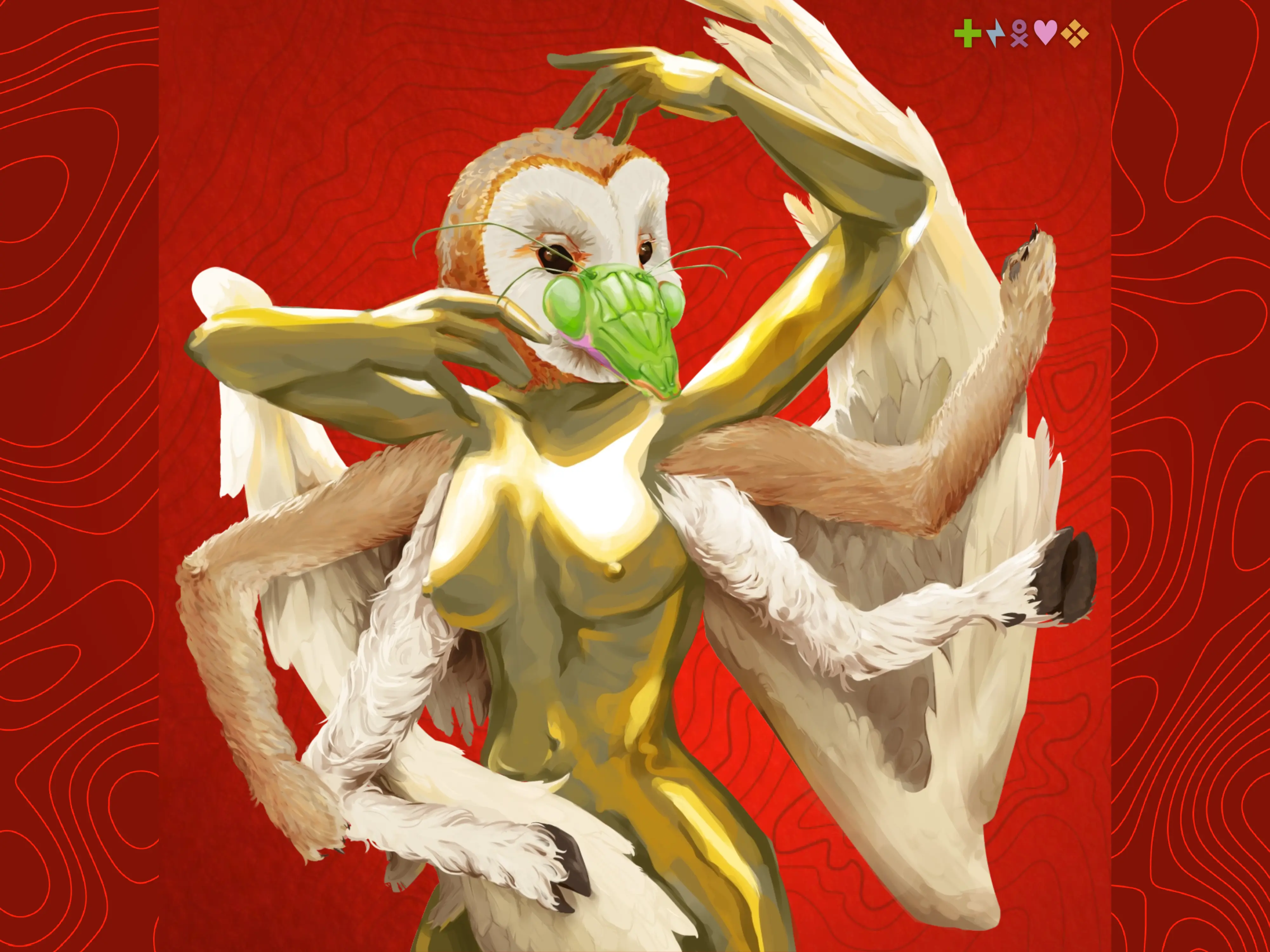
I don’t know when exactly it was that I first searched up tracey brakes — or why, for that matter. My fingers appeared over the keys and my twee monsters appeared before my eyes, a bizarre human chimera against a blood red backdrop. I remember listening through it absentmindedly a few times, finding it novel if nothing else, since I hadn’t listened to much similar music before. Then, well, I moved on. Until earlier this month, that is, when I spontaneously, and again for no discernible reason, found myself typing her name into another search bar. This time, it was Bandcamp, and I scooped up my twee monsters the second I saw its resounding price tag of a single dollar.
You may recall that I’ve written before about my switch from streaming services to local media players, and though I gestured at WACUP back then, I recently jumped to the program foobar2000 (yes, I know, the title gives mad scientist vibes). I’ve set it up, with my fumbling “technological know-how”, to be a dark, tranquil, verdant green. When I listen to music, the lyrics float by in a panel on the left, and an oscilloscope at the bottom completely mesmerizes me more often than it probably should. Who knew waveforms could be so captivating? Is this how cats feel when they see a laser pointer and suddenly nothing else matters? It’s been horrible for my productivity margins, but great for my engaging-more-fully-with-the-music-I-listen-to margins.
This is to say that I sat down for the first time recently and listened — really, truly listened — to tracey brakes’ my twee monsters, and found embedded in the processed vocals, enveloping noise, and occasional tasteful celesta (as nearly all celestas are) a deeply emotional exploration of trans identity and the act of transition that had mostly flown over my head on my first pass.
The prevailing metaphor, as the title suggests, is one of monstrosity; we get allusions to scales, claws, muzzles, horns, and hooves sprinkled throughout, suggesting no one discrete animal, but rather a shifting chimera, a collaged identity at once unknowable and unnatural to her surrounding environment. The social consequences of transition are grafted directly onto her body — as relationships splinter, so too does bone and skin, until the denial of her humanity is made manifest physically. This transformation itself goes on to spark self-hatred and isolation, as the monster she sees in the mirror only confirms the narratives she has internalized from the very people who seek to destroy her.
We see the end result of this internalization in “behave, hollow automaton”, which deals directly with cycles of self-harm. We’re introduced to cassettes here as a symbol, used as a record of all the speaker’s mistakes, played back on indefinite loop. The word itself is pronounced with the first syllable stressed (CA-sette), lending it an unusual sharpness, a cutting edge much like the razor with which “she marks the progress on her arm”. She transcribes her record into her own flesh, trauma once again etched into her very body. This time, it’s accomplished by her own hands, rather than being an imposed transformation she has no control over. And yet, both instances are guided by the very same forces.
These themes are, unfortunately, not exactly new concepts in the realm of trans artistic expression. As I’ve perused work by more trans artists over time, I’ve seen dehumanization and violence in particular crop up again and again. Femtanyl sings, “Treat me like your pet”; STOMACH BOOK, “If you wanna flay me, let’s see what’s inside”; saoirse dream, “I’m a bug on my back, and you rip my limbs off”; and on and on. Who’s the “you” in any of these scenarios? Most commonly, it’s either directed broadly at a subjugating dominant society, or an individual who is treated in that particular instance as a representative of it.
But tracey brakes does something a little different in my twee monsters. Yes, there are certainly moments — as in “orphan source” and “carbonhead” — where her relation to cis society is touched on. But throughout the vast majority of the album, “you” doesn’t refer to an external audience, but rather an internal one: herself. A good example can be found in the second verse of “endorphin heist”, my favorite track (and not just because it samples the Wii pointer click sound effect, though that doesn’t hurt):
“
Pressure spent, now you’re already dead
And your thoughts are on a speaker looping over again
It was never in the cards, you never had any chance
TV static in your eyes, your claws make nothing but sense
”
Claws return as a marker of monstrosity: her monstrosity. A reference to mirrors (a frequently recurring symbol) directly before this passage reinforces the internal nature of the dialogue. In a similar manner, she speaks of an unnamed third-person “her” in “behave, hollow automaton”, which serves as yet another reference to herself (this time, dissociative rather than reflective). The self-contained nature of both the speaker and her direct audience (that is, the lyrics’ second-person) is what lends the album its deeply introspective character, but at the same time, the shifting perspective of pronouns is corrosive to that container of the self. Her identity unravels like a spool of yarn — the “I” loses a solid definition when that same figure is also “you” and “her”. The forces that did this to her, meanwhile, reside mostly in the negative space.
The greatest exception to this is the aforementioned “carbonhead”, the album’s final track, which heavily features quotes directed at the speaker from outside (such as the chorus’s refrain of “you can feel what you want, but see, this complicates things and I don’t wanna deal with you”). But even so, there’s still a distance present — these are memories rather than confrontations, played, once more, on a looping cassette “feedbacking endlessly” in her head. The words are largely detached from the people who spoke them, and in removing them from a physical, experiential context, the speaker loses any sense of agency. When face-to-face in conversation with someone, you can do something; you can act, you can respond. But against words floating in the air, you’re helpless. They suffocate you.
my twee monsters is not an album that affords any solace to its speaker — nor its listeners, for that matter. The very best it can offer is that to become a monster “feels so much better than nothing changing at all”. But how to become yourself? It has no answers. Instead, the pain it outlines is cyclic, each playthrough of the album serving as a single instantiation of that pain. We as listeners are looping the cassette, too. Does it hurt us? Or do we find its familiarity somehow comforting?
In a world so dismissive of trans people’s stuggles, maybe it’s the pain itself that we’re after, just to convince ourselves that it’s real.